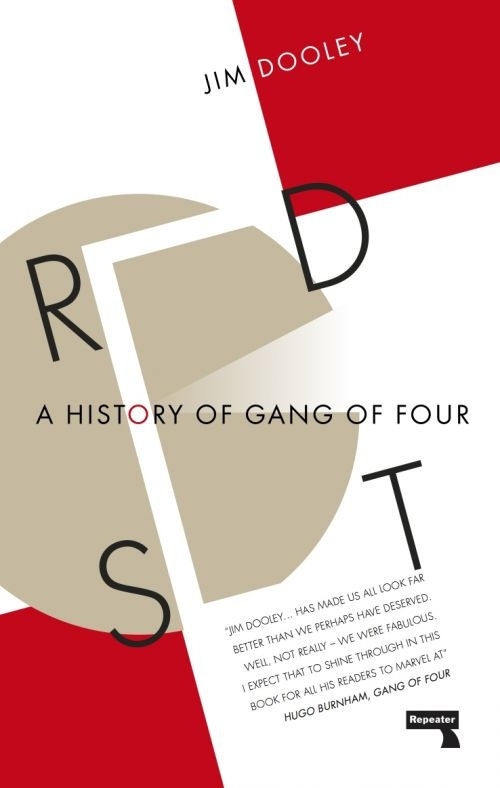
Red Set
On Gang of Four

Perhaps I’m attracted to things I don’t immediately understand… or might never fully comprehend. I think I have a soft spot for art that I find both appealing and challenging. As a long-time fan, I might not have always been able to grasp where Gang of Four were coming from, but they did make me endlessly curious. The band did not supply answers (as if answers were possible to their questions) but both during their prolific period and now, years later, it feels like they were making the right inquiries about our era: to what extent do we hold ourselves down and construct our own enclosures? How are we implicated in larger networks of power and exploitation? Are we actors in someone else’s play or spectacle? How and why do our daily lives seem natural to us? Yet despite the weight of this material, the band still managed to be lively and funny. Furthermore, none of the lyrical content would have added up to much if the music had not been challenging and engaging as well; the sounds also made inquiries and tested conventions. What seems to have made Gang of Four particularly special was that their lyrics, music and accompanying artwork seemed to work in unison to pose uncomfortable, often funny, questions.
Observant Gang of Four fans will have noticed that there are a couple of books on the band in print. In some ways it was my disappointment with the first book to address the band, Paul Lester’s Damaged Gods, that prompted me to take up this writing challenge. While Lester’s work is not without interesting passages, I thought a book that focused more on the band’s output, rather than their personalities and group infighting, was in order. Similarly, Kevin Dettmar’s recent 33 1/3 book focusing on the group’s debut album, Entertainment!, is highly engaging and full of interesting information. While I enjoyed Dettmar’s work, I felt that stopping at the initial album meant that a great deal of the group’s interesting material remained unexplored. Considering later releases alongside Entertainment!, rather than looking at this first successful album in isolation, reveals how the group’s output could be viewed as a continuous progression or arc. In both cases I wanted more information – more detail! I felt it was necessary to start with the group’s formation and then look both forward and backward in time. What albums were the members listening to as teenagers? What were the first concerts they attended? And following their initial success, what later material revisited or expanded the ideas sketched out in those early songs? How and why did they influence emerging artists over the span of decades? Basically, I wanted to examine what made the group special.
The idea was to not exclusively present facts or biographical data, but to look at the group’s output and how it tied into the music industry specifically and our times generally. I hoped to explore the ideas behind the group without writing an academic tome: I wanted a project that was informative, readable and fun. This quest was, I think, made quite easy by the band members, who each provided information that was insightful and humorous in equal measure. Whenever possible, I’ve attempted to get the group members themselves to comment on the group’s output and their respective career decisions. A multi-party collaboration was what I had in mind.
I initially interviewed Jon King and Andy Gill for an ongoing project investigating how Jamaican dub music had influenced seemingly unrelated genres. I was immediately struck by how much they knew about a very wide variety of topics. Unlike many musicians, they were not embarrassed by, or trying to disguise, their education. While clearly they are very creative people, there was open acknowledgement that ideas did not come to them fully formed without sources. Gill and King both enjoyed talking about how, for instance, books, painters and filmmakers shaped their music.
The duo also seemed to be constantly scrutinising their output. What were they trying to say? Was the outcome successful? Was it possible to challenge and engage people with catchy rock songs? Could songs carry weight without sounding weighty? While never entirely without humour, or dry-as-dust irony, there seemed to be a constant examination and questioning of both the songs and the motives behind the work. Needless to say, this type of ongoing self-inquiry, and occasional self-doubt, made for riveting interviews. It always felt like a rare occasion, or victory, when I came up with a question they hadn’t previously considered.
On more than one occasion, when I asked Jon King a question, the singer prefaced a response or anecdote with: “This is either true or it isn’t.” I took the point to be that I should not get overly absorbed in details at the expense of a larger picture. In many cases I was interviewing people about incidents that had taken place decades earlier. Often I was given what were admittedly opinions or I was supplied with conflicting accounts of the same event. So what exactly is “truth”? This isn’t to say “facts don’t matter” so much as it is an attempt to avoid presenting rigid lists of names and dates. My other guide was drummer Hugo Burnham, who reminded me at least twice: “Don’t forget the fans.” I certainly hope I come off as a fan… an admirer who is perhaps both critical and conditional.
All quotations in the book are from interviews I conducted unless otherwise stated. In addition to conducting over thirty interviews myself, I have drawn on a multitude of sources in an effort to capture how Gang of Four have been reviewed and how the members have interacted with the media over the years. I certainly don’t think for a second that I coaxed the best, or final, words out of the group. Perhaps it says something highly complimentary about the band that their output has prompted fantastic work from such music writers as Greil Marcus, Robert Christgau, Simon Reynolds, Jon Savage, Mary Harron, Clinton Heylin, Garry Mulholland, Charles Shaar Murray and most recently Kevin Dettmar. In many ways the Gang of Four interviews, and the articles written about the group, have become part of the riveting story. Of course, in light of the creative and engaging output by some of these writers, my task seemed all the more daunting.
What has sustained my interest over the years is that, in spite of pursuing numerous interviews and taking on mountains of reading, the Gang of Four output remains both mysterious and counterintuitive. The music is groovy, but it doesn’t easily settle into a groove. The words are everyday, but what they say isn’t always obvious. Some songs have come to resonate with me years, or decades, after they were released. When I least expect it, lines such as “I’m an understudy for myself” or “Trapped in heaven life style” pop into my mind with an acute, if sometimes fleeting, clarity. At the same time, often a pulsing bass line, hypnotic drumbeat or piercing guitar note will be in my head for no obvious reason. And yet it seems almost impossible to break the group’s best work into isolated elements. It is the dialogue between the various voices and instruments that delivers the content. It is within these tensions that the difficult and irresolvable questions are asked.
Continue reading in Red Set: A History of Gang of Four, by Jim Dooley, available now from Repeater Books